Overview
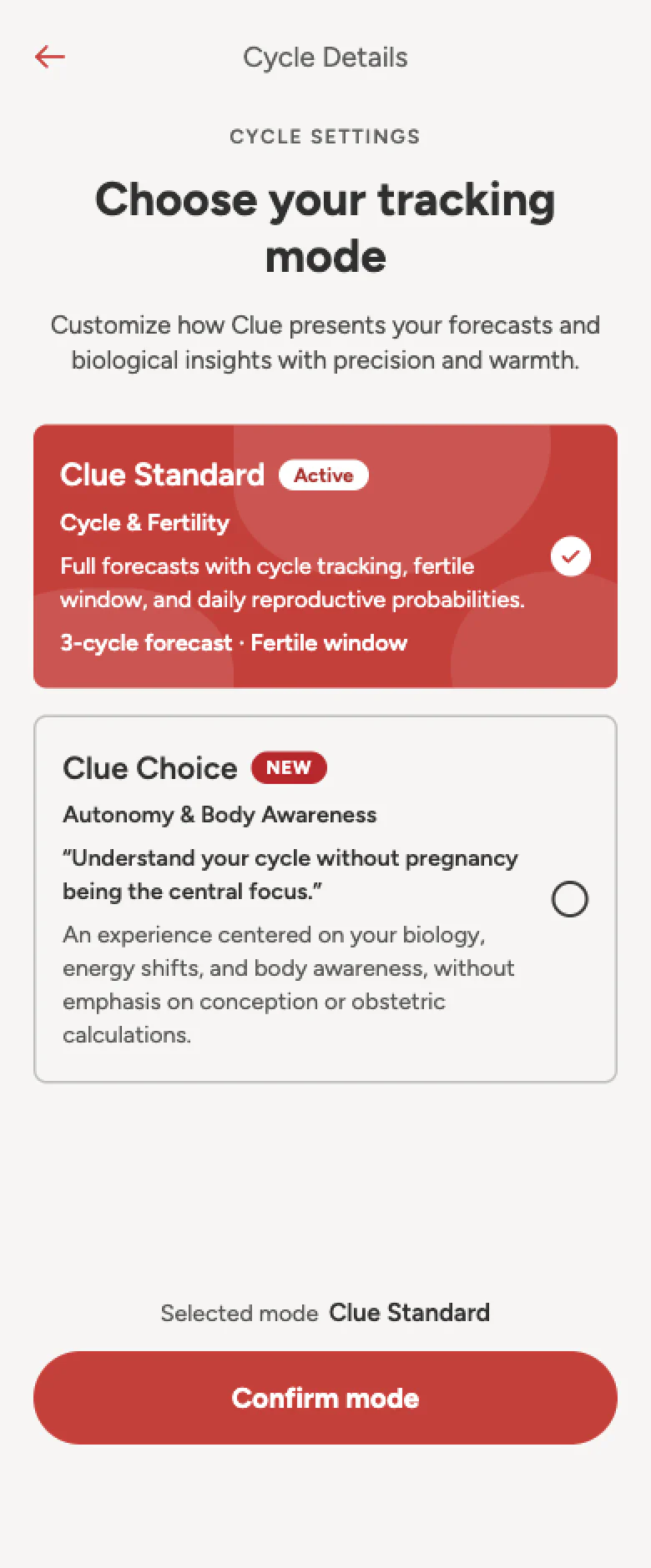
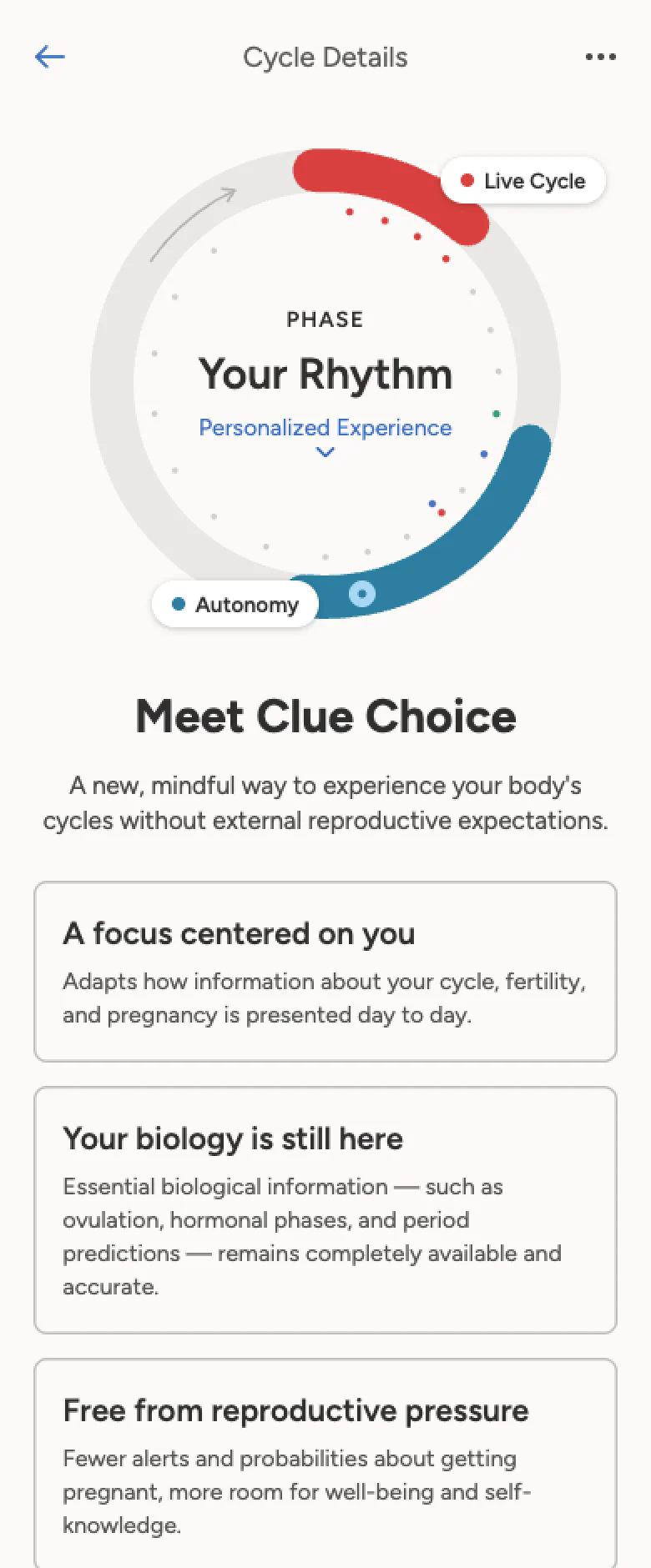
Clue Choice is a product concept for a preference-based menstrual tracking experience. Instead of assuming one reason for tracking, the experience adapts to the user’s context and lets her choose what to track, and why.
I developed it as my capstone project at SPICED Academy: from user research to a prototype tested with target users, a prioritised MVP and a phased launch plan. It is a concept project. The features described here were designed and tested as a prototype, not built into a live product.
The Problem
People track their cycles for very different reasons: to avoid or plan a pregnancy, to manage symptoms, to understand their bodies, or simply to keep a record. My starting hypothesis was that a one-size-fits-all experience serves these goals poorly — it asks for data some users do not want to share, and offers insights others do not need.
How might a cycle-tracking app adapt to each user’s context, without asking her to give up control over her data?
My Role
I owned the project end to end as product manager: planning and running the research, synthesising findings, defining the product strategy, prioritising the MVP and backlog, building the prototype, running the usability tests and writing the launch plan.
Approach
- User research with people who track their cycles, synthesised into personas and user journeys.
- Problem definition and strategy, framing who the product is for and which needs come first.
- AI-assisted prototyping with Google Stitch, to move quickly from concept to testable screens.
- Usability testing of the prototype with target users.
- MVP and backlog prioritisation, experiment success criteria and GDPR-related requirements for sensitive health data.
- Research People who track their cycles
- Personas & strategy Who tracks, and why
- Prototype AI-assisted, in Stitch
- Usability tests With target users
- MVP & launch plan Prioritised backlog
View the prototype in Google Stitch →
Evidence & Insights
- Tracking goals differ enough between users that a single default journey does not fit them all — the basis for making personalisation the core of the concept.
- Cycle data is sensitive health data. Control over what is collected and shared had to be part of the product, not an afterthought — which is why GDPR-related requirements were defined alongside the MVP.
- Usability testing showed where the prototype was clear and where the flow needed work, and fed directly into the prioritised backlog.
Decisions & Experiments
- Built a clickable prototype of the personalised onboarding and tracking experience. Done
- Tested the prototype with target users. Tested
- Prioritised an MVP and backlog around preference-based tracking. Proposed
- Defined success criteria for experiments to run after launch. Proposed
- Drafted a phased launch plan. Proposed
Outcomes & Learnings
The project delivered a validated problem definition, personas and journeys, a tested prototype, a prioritised MVP and backlog, and a phased launch plan.
- AI-assisted prototyping changes the rhythm of discovery. Getting to testable screens quickly made it possible to put real interfaces in front of users early.
- Personalisation and privacy are the same design problem in women’s health: adapting to someone’s context only works if she stays in control.
- Being explicit about what is proposed and what is built keeps a product conversation honest.
Next Steps
- Run the first experiments defined in the launch plan and measure them against the success criteria.
- Test the personalised journeys with a larger and more diverse group of users.